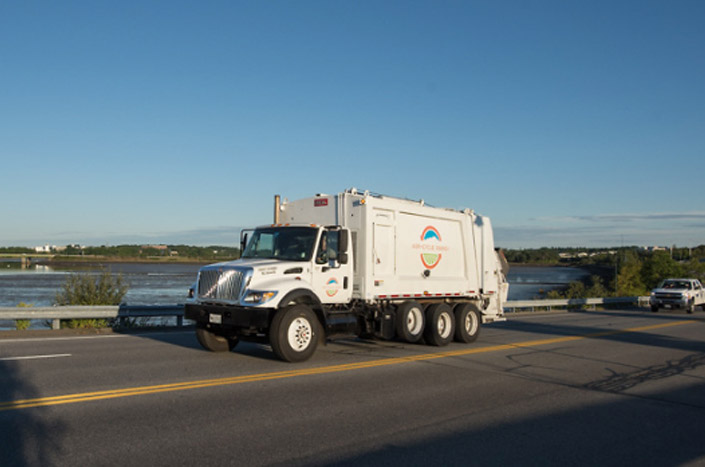
Toter service
Scheduled route collection using 64-gallon totes, sized for crowded kitchens and busy loading docks alike.
Ideal for
- Grocers
- Restaurants
- Residential drop-off
- Universities & schools
- Hospitals
- Municipalities
Whether you’re a school, hospital, grocer, restaurant, brewery, or dairy, we have a food-waste management service to meet your needs.
Scheduled route collection using 64-gallon totes, sized for crowded kitchens and busy loading docks alike.
Ideal for

Vacuum-pump tanker trucks for producers whose organics arrive by the thousand gallons.
Ideal for
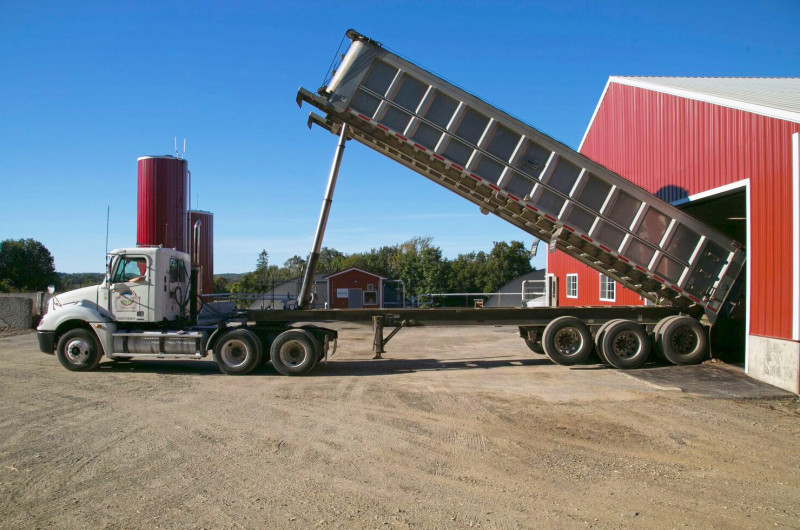
Roll-off containers, gaylord boxes and palletized pickups for mass loss, recalls and one-off events.
Ideal for
Our diverse fleet includes rear-loading collection trucks for toter service and tractor-trailers for hauling up to 8,500 gallons of liquids and 65 yards of solids, as well as palletized waste materials.

Agri-Cycle provides services to all food waste producers throughout the United States.

If you care about the planet and want to use sustainable practices at your business, town, or school, call Agri-Cycle today to customize a program that meets your needs and goals. Agri-Cycle makes it easy for you to become part of a sustainable waste solution by working with you to customize a service based on your needs. All you have to do is put your food waste in our designated container and we’ll take it from there. If your business or organization needs a solution for wasted packaged food, we can take that material as well; check out the FAQ on our state-of-the-art depackager.
Agri-Cycle operates a fleet of collection vehicles dedicated to both solid and liquid food waste collection. We accept all types of organic waste streams including produce, meat, seafood, and dairy, as well as brewery and other industrial food waste. Our fleet is capable of collecting palletized packaged food waste, either as part of our scheduled routes, an emergency or an on-call basis.
Agri-Cycle works with thousands of partner locations throughout the US, making it a premier organics hauling company in the nation. Our partners include supermarkets, restaurants, universities, distribution centers, food processing plants, corporate cafeterias, school districts, municipalities, and hospitals. Agri-Cycle is a hauling company that partners with a robust network of anaerobic digesters, composters, and animal feed outlets across the country in offering the very best solution for your organic waste stream. In short, Agri-Cycle brings food full circle.
State policy
Tap a state to see its food waste rules and the bills its legislature took up in 2026. Regardless of your state’s laws, diverting scraps from landfill disposal reduces your trash and trash fees, cuts greenhouse gases, and creates renewable energy and farm products.
2026 food waste bills
In 38 state legislatures. Tracker updated July 21, 2026.
Food waste bills in the 2026 session
The Food Waste Recycling Law requires large generators to divert food waste when an authorised facility is within range.
2026 bills
2 enacted24 pending1 dead
Waste Reduction
Jan 13, 2026 — Withdrawn Because Approved P.L.2025, c.228.
Schools
Jan 13, 2026 — Withdrawn Because Approved P.L.2025, c.309.
Tax Incentive
Jun 8, 2026 — Referred to Senate Budget and Appropriations Committee
Donation Program or Donation Requirement
Jun 1, 2026 — Introduced in the Senate, Referred to Senate Health, Human Services and Senior Citizens Committee
Composting/AD Permitting
May 4, 2026 — Received in the Senate, Referred to Senate Environment and Energy Committee
Tax Incentive
Mar 19, 2026 — Introduced, Referred to Assembly Agriculture and Natural Resources Committee
Donation Program or Donation Requirement
Mar 19, 2026 — Introduced in the Senate, Referred to Senate Environment and Energy Committee
Other
Feb 24, 2026 — Introduced in the Senate, Referred to Senate Economic Growth Committee
Funding
Feb 12, 2026 — Introduced, Referred to Assembly Agriculture and Natural Resources Committee
Awareness, Date Labeling
Jan 13, 2026 — Introduced, Referred to Assembly Consumer Affairs Committee
Donation Program or Donation Requirement
Jan 13, 2026 — Introduced, Referred to Assembly Children, Families and Food Security Committee
Tax Incentive
Jan 13, 2026 — Introduced, Referred to Assembly Agriculture and Natural Resources Committee
Composting/AD Permitting
Jan 13, 2026 — Introduced, Referred to Assembly Environment and Solid Waste Committee
Other
Jan 13, 2026 — Introduced, Referred to Assembly Environment and Solid Waste Committee
Source Separation and Recycling Requirements
Jan 13, 2026 — Introduced, Referred to Assembly Environment and Solid Waste Committee
Composting/AD Permitting
Jan 13, 2026 — Introduced, Referred to Assembly Environment and Solid Waste Committee
Schools
Jan 13, 2026 — Introduced, Referred to Assembly Children, Families and Food Security Committee
Liability Protection
Jan 13, 2026 — Introduced in the Senate, Referred to Senate Environment and Energy Committee
Date Labeling
Jan 13, 2026 — Introduced in the Senate, Referred to Senate Environment and Energy Committee
Source Separation and Recycling Requirements
Jan 13, 2026 — Introduced in the Senate, Referred to Senate Environment and Energy Committee
Donation Safety, Schools
Jan 13, 2026 — Introduced in the Senate, Referred to Senate Environment and Energy Committee
Awareness, Donation Program or Donation Requirement
Jan 13, 2026 — Introduced in the Senate, Referred to Senate Health, Human Services and Senior Citizens Committee
Composting/AD Permitting
Jan 13, 2026 — Introduced in the Senate, Referred to Senate Environment and Energy Committee
Funding
Jan 13, 2026 — Introduced in the Senate, Referred to Senate Health, Human Services and Senior Citizens Committee
Awareness
Jan 13, 2026 — Introduced in the Senate, Referred to Senate Environment and Energy Committee
Schools
Jan 13, 2026 — Introduced in the Senate, Referred to Senate Environment and Energy Committee
Other
Jan 13, 2026 — Withdrawn Because Approved P.L.2025, JR-19.
Tile positions are stylised, not geographic. Organics policy changes often and thresholds vary by facility distance and generator size — confirm current rules with your state, or check the ReFED Policy Finder, produced with the Food Law and Policy Clinic of Harvard University. Bill status from the state legislation tracker Divert and the Harvard Law School Food Law and Policy Clinic keep for the Zero Food Waste Coalition, updated July 21, 2026.
Many states place bans on businesses that produce large amounts of food waste — usually 50 to 100 tons annually, and in some states far less.
Some bans extend to residents as well, with a focus on removing food waste from individual households’ garbage.
Many residential bans or incentives sit at the city or county level for large urban centers. Check whether one of your locations is covered.
Some states instead provide tax breaks and other incentives for food donations or other higher-use situations.
Agri-Cycle’s diverse fleet and expertise makes it possible for us to service your business or institution no matter where you are or how much waste you generate.
We partner with a close-knit network of digesters throughout the country to create a sustainable web of waste diversion. This means that your waste never travels further than necessary to reach its final destination. To do it any other way wouldn’t make sense – environmental or otherwise.
From Maine to California, chances are we’re passing by your business, school, or home – so keep an eye out for the Agri-Cycle logo in a neighborhood near you!